
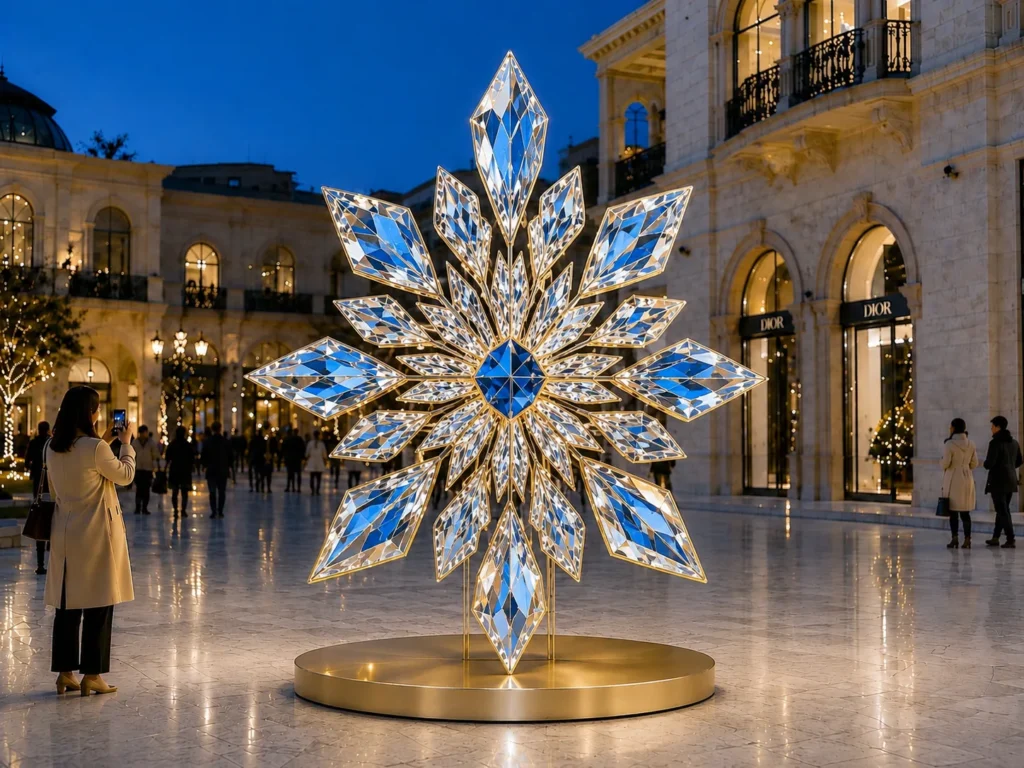
A mall Christmas display looks like a decoration decision. In practice it is a fabrication decision, and the date that matters is not the day the lights go on. It is the day the factory can still build, test, pack and ship the pieces without cutting a corner that will show on opening night.
A mall should order its Christmas display early enough that the design is settled, the structure and lighting are agreed, and the site measurements are confirmed well before opening. AlisnArt builds, tests, packs and ships the pieces to the opening date, and the date that matters is the day the factory can still do that without cutting a corner.
A mall Christmas display is a large seasonal centrepiece — usually in a mall atrium — that gives visitors one place to stop, look up and take a photo, and gives the mall one image it can use all season.
That is why the first question is not “what should it look like?” It is “when does it have to be open, and what has to be true by then?” A display that opens in early December needs its design settled, its structure and lighting agreed, and its site measurements confirmed well before that. If any of those three is still moving, the factory is not really building yet — it is waiting, and the opening date is not.
Start with the opening date and work backwards in plain steps. First, the concept and the site: where the display will stand, how visitors will walk around it, how tall it can be, where power comes from, and what the mall’s own team will install versus what arrives ready to assemble. Second, the drawings: approved drawings, dimensions, and the finishes the buyer has actually signed off. Third, fabrication: cutting, forming, joining, painting, lighting and testing in the factory. Fourth, packing and delivery: modular pieces, export packing, and coordination to the delivery destination. Each step needs the one before it. A delay in the first step does not disappear; it moves into the last one.
The most common delay is not in the factory. It is in the information the factory is waiting for. A useful enquiry, sent early, contains the site photos, the floor plan or atrium dimensions, the height limit, the opening date, the budget range, and one or two reference images that show the feeling the mall wants — not a finished design the factory is expected to copy exactly. With that, a manufacturer can review fit, raise the questions that change the scope, and say what is feasible before anyone talks about price in detail.
ALISN has completed high-end Christmas and festive displays in large numbers every year — that category is a proven, repeat strength, confirmed by the company on 2026-11-03. Specific project names, dates, sizes and materials for those seasonal cases are Not verified, so this article names none of them. The point is not a single past display. It is the pattern: the malls that open on time are usually the ones that sent a complete brief early, agreed the scope in writing, and left room for factory testing and packing.
Three practical checks help a buyer judge whether a supplier is ready for a seasonal deadline. First, does the supplier separate what it will fabricate from what the mall or its local contractor must do on site — foundations, power, lifting, permits and final installation? Those responsibilities are confirmed for each project, and they should be written down before fabrication starts. Second, does the supplier ask for the site and the drawings before quoting, rather than quoting from a single photo? Third, does it plan for pre-assembly and testing in the factory, so a lighting or fit problem is found where it can still be fixed?
If the answer to those checks is yes, the next step is simple: send the site, the drawings or reference images, the dimensions, the opening date and the budget range, and ask for a feasibility review. A project schedule is then prepared after the scope, drawings, materials, approvals, testing, packing, delivery destination and site responsibilities are reviewed. No fixed lead time is promised before that review — and a supplier that promises one before seeing the site has not really reviewed the project.
The display itself should do one job well. For a mall atrium, that is usually to give visitors one place to stop, look up, and take a photo — and to give the mall one image it can use all season. A display that tries to do everything often does none of it clearly. One strong centrepiece, with lighting that changes slowly enough to feel calm rather than busy, usually reads better in a real atrium than a dozen competing pieces.
If your opening date is already set, the useful question to ask now is not whether a display can still be made. It is what information the factory still needs from you, and by when, for that date to stay real. Send that information, and the conversation can move from ideas to a scope both sides can stand behind.
Next step: send your site photos, drawings or reference images, dimensions, opening date and budget range via the Request a Quote form on alisnart.com, or contact Vicky at vicky@alisnart.com. ALISN will review project fit and the next design or quotation step.