
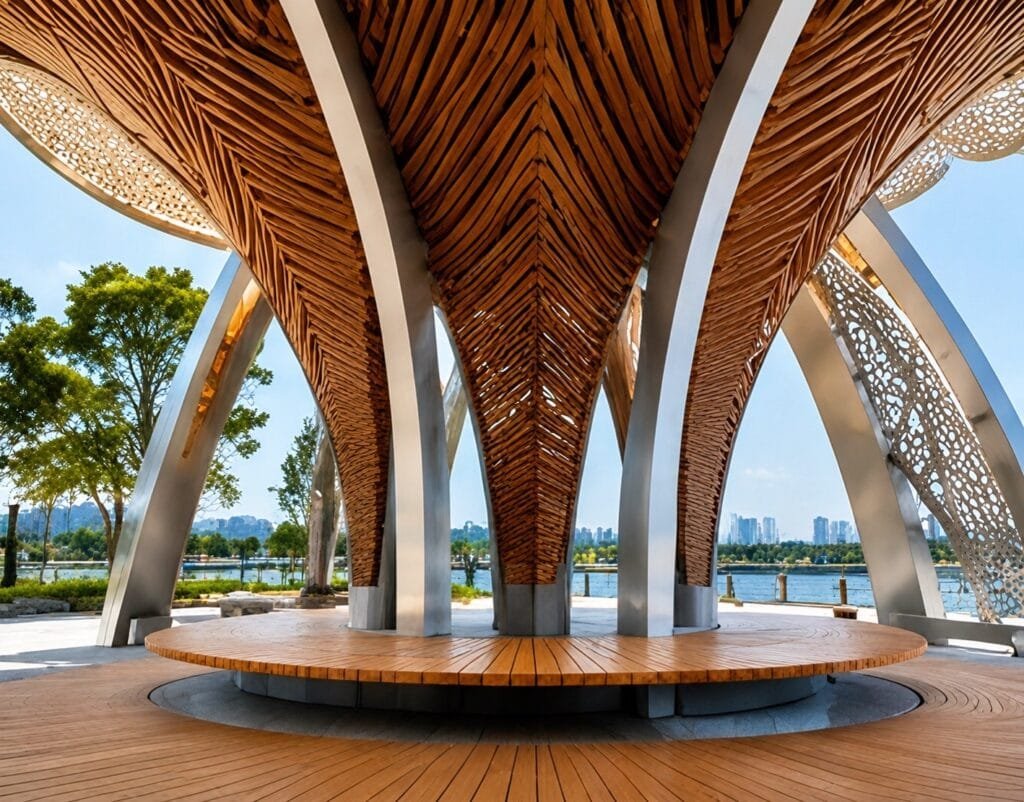
How do you commission a custom sculpture for a private garden or estate? Start with the view, not the catalogue: stand where you will see it from, decide what the piece must do at that spot, and agree the size, the material, and the base before you order.
To commission a custom sculpture for a private garden or estate, AlisnArt advises starting with the view, not the catalogue: stand where you will see it from, decide what the piece must do at that spot, and agree the size, the material, and the base before you order.
A private garden sculpture is a custom sculpture made for a specific garden, sized to its viewing distances and built to live outside in all weather.
Start with where it will be seen from
A private garden sculpture is seen from places the buyer already knows: the kitchen window, the terrace, the end of a path, the gate. That is where the commissioning starts, and it is the part most often skipped. A piece chosen from a photograph looks right in the photograph. It does not always look right from the window it will be seen through for the next ten years.
Stand at each viewing point and look at the spot, not at the sculpture. How far away is it? What is behind it — a hedge, a wall, a tree line, open sky, water? What time of day does the light hit it, and from which side? A piece that reads clearly against planting can disappear against a pale wall. Those answers are the brief, and they decide the form, the finish, and the height before a drawing is made.
Size it to the space, not to the catalogue
The most common mistake in a private commission is choosing a size from a list, rather than from the space. A sculpture that is too small for a wide lawn looks lost, however good it is. The garden decides the size, and the garden is measured in viewing distances, not in square metres alone.
A practical way to test the size is to stand at the main viewing point and imagine the piece at about one-third the height of whatever stands behind it — the tree line, the hedge, or the wall. Then check how close someone will get to it. A garden piece is walked up to: people touch it and photograph it at close range, so a form that only works from twenty metres away will disappoint at two.
Material, finish, and weather
A garden sculpture lives outside in all weather, and the material question is really a maintenance question. Stainless steel and FRP are both real choices for large outdoor work. Stainless steel suits clean, reflective forms that hold their line in daylight and catch light at night. FRP suits complex, curved or organic forms that would be hard to form in sheet metal. The choice is not about which material is better in general. It is about which one fits this garden, this shape, this finish, and this maintenance reality, and our earlier guide on stainless steel or FRP explains how to weigh those three together.
The garden itself answers the rest. Is it coastal or inland? Shaded or in full sun? Near a pool, or under trees? Who will clean it, and how often — the owner, a gardener, a maintenance team? A mirror surface shows every fingerprint and water mark. A painted surface needs its finish protected from sun and salt air. Neither is a problem, as long as it is chosen knowingly, with the care written into the handover.
The base, the foundation, and who does what
The base is not an afterthought. It raises the work to the right viewing height, carries its weight safely through wind and time, spreads the load so the piece does not sink or tilt, and keeps the bottom of the work clear of pooled water and soil splash. A sculpture set directly on paving reads as unfinished, and it is far more exposed to moisture and accidental contact. Planning the base first also fixes the total height.
For a large piece, the base is a small structure in its own right. The ground beneath it, the drainage around it, the anchoring that holds it against wind, and the access a crane or a small team will need — all of these are decided with the buyer’s local team, not by the factory alone. The factory can supply the loading information its engineers have reviewed for the piece, so the buyer’s local structural engineer can design the footing. Engineering certification, structural performance, and local installation are confirmed per project; they are not promised in an article.
That split — what the factory makes, and what the local team does on site — should be written down before fabrication starts. For a private garden it is usually simple, but it still needs writing down: who casts the foundation, and by when; who brings the crane; who receives the delivery, and where the crates can be stored; who assembles the piece. A one-page scope split prevents the most common arrival-day surprise: a beautiful piece, a finished garden, and nobody booked to put the two together. A large piece travels as sections, packed for export — our guide on export packing and shipping for large custom sculptures explains what to expect.
Commissioning a custom sculpture for a private garden: what a good brief contains
A good private brief fits on one page, and it is the fastest way to a useful quotation. Send the site photos from the viewing points, not only from the spot; the garden plan or the dimensions of the space; the height limit, including the base; the installation date, if there is one; and the budget range. Say what the piece is for, in one sentence, and say who is responsible for the foundation, power, lifting, permits, and final installation — or say that this is still to be agreed.
A manufacturer can then review fit, ask the questions that change the scope, and explain what still needs a local engineer or approval body to confirm. Two mistakes are worth avoiding: specifying a material from a single photograph, without the site or the dimensions, and asking for a price before the scope is split. A price without that split is not a comparison — it is a guess.
Frequently asked questions
Next step: send your site photos, drawings or reference images, dimensions, opening date and budget range via the Request a Quote form on alisnart.com, or contact Vicky at vicky@alisnart.com. ALISN will review project fit and the next design or quotation step.